|
|
|
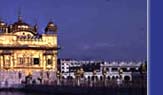
Sachkhand Sri Harmandir Sahib Sri Darbar Sahib
|
Sachkhand Sri Harmandir Sahib Sri Darbar Sahib is the central religious place of the Sikhs. The Sikhs daily wish in Ardas (prayer) to pay their visit and obeisance at this sacred place. The people belonging to other religions also visit daily to pay their obeisance. Earlier, the planning to establish a new Sikh centre was chalked out by the third Guru, Sri Guru Amardas Ji. He decided to settle a new religious centre on the land between the village of Sultanwind, Tung, Gumtala and Gilwali after consulting with Sri Guru Ramdas Ji, Baba Budha Ji and other prominent Sikhs. So, this town was founded by fourth Guru Sri Guru Ramdas Ji with the advice of Sri Guru Amardas Ji. Earlier, it was known as Chak Guru, Guru Ka Chak, Chak Ramdas or Ramdaspura. Later, it came to be known as Amritsar. The construction of Amrit Sarovar was commenced under the supervision of Sri Guru Ramdas Ji with the help of Sangat. Fifth Guru, Sri Guru Arjan Dev Ji established a central place of worship Sri Harmandir Sahib Sri Darbar Sahib in the middle of sacred Sarovar. The foundation stone of Sri Harmandir Sahib Sri Darbar Sahib was laid in 1645 Bikrami Samvat (1588 CE). The construction work was supervised by Sri Guru Arjan Dev Ji himself as well as assisted by the prominent Sikhs like Baba Budha Ji, Bhai Gurdas Ji, Bhai Sahlo ji and many other devoted disciples. Sri Guru Arjan Dev Ji got built the four doors and made is accessible to every person without any distinction of cast, creed, sex and religion. He installed Adi Sri (Guru) Granth Sahib Ji on Bhadon Sudi 1st, 1661 Bikrami Samvat (August, 1604 CE) at Sri Harmandir Sahib Sri Darbar Sahib and appointed Baba Budha Ji as its first Granthi.
Presently, lakhs of devotees visit daily to Sachkhand Sri Harmandir Sahib Sri Darbar Sahib and take holy bath in Amrit Sarovar. Sangat also listen to the blissful Kirtan that begins from Amrit Vela (Early dawn) till Sukhasan (Closing) of Sri Guru Granth Sahib Ji. There is a multi-storied langar hall remains open for 24 hous where Sangat take meal in Pangat without any discrimination.
|
 |
| |
|
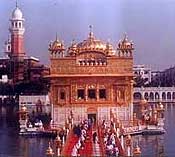
Sri Akal Takht
|
| Akal
Takht literally means Eternal Throne. It is part of the Golden Temple
complex in Amritsar. The Akal Takht is situated on the other end of
the causeway connected to the Harmandir Sahib. It's foundation was
laid by Guru Hargobind. It was here that he was ceremonially installed
as Guru in 1606. The building of the Akal Takht opposite the Golden
Temple has a special meaning. While the Golden Temple stands for spiritual
guidance the Akal Takht symbolizes the dispensing of justice and temporal
activity. During the day the Guru Granth Sahib is kept in the Golden
Temple, while at night it is kept in the Akal Takht. Traditionally
all Sikh warriors sought blessings here before going to battle. During
the 18th century while Sikhs were fighting a guerrilla war in the
forests they used to gather at the Akal Takht on special occasions
such as Baisakhi and Diwali. Here the community used to have general
meetings and approve resolutions. The Akal Takht was the oldest of
the Five Takhts. |
 |
| |
|
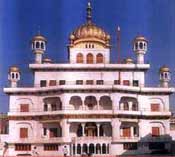
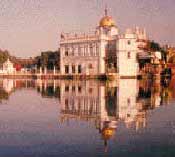
Durgiana Temple
|
| Also called the Lakshmi
Narayan Temple, located outside the Lohagarh gate of the old city,
this temple dedicated to Goddess Durga dates back to the 16th century
and is a centre of pilgrimage for devout Hindus. In its present form
the temple echoes of not the traditional Hindu temple architecture,
but that of the Golden Temple. It rises in a similar manner from the
midst of a tank and has canopies and a central dome. Its foundation
stone was laid by one of the greatest reformers and political leaders
of resurgent India, Pandit Madan Mohan Malviya. It is a well-known
repository of Hindu scriptures. |
 |
| |
| |
|